


Family Toyota of Burleson

Blog / Model Comparison

Blog

All Model Comparison Burleson Toyota Dealer Toyota Car Guide Car Comparison Family Toyota Burleson Tips and Tricks Accessories Burleson Toyota Service Burleson Used Cars Certified Pre-Owned Electric Vehicles Lifestyle Toyota Service Toyota Smartpath Toyota Trucks Toyotacare
Toyota Prius vs. Prius Plug-in Hybrid: What’s the Difference?

Toyota Prius vs. Prius Plug-in Hybrid: What’s the Difference?

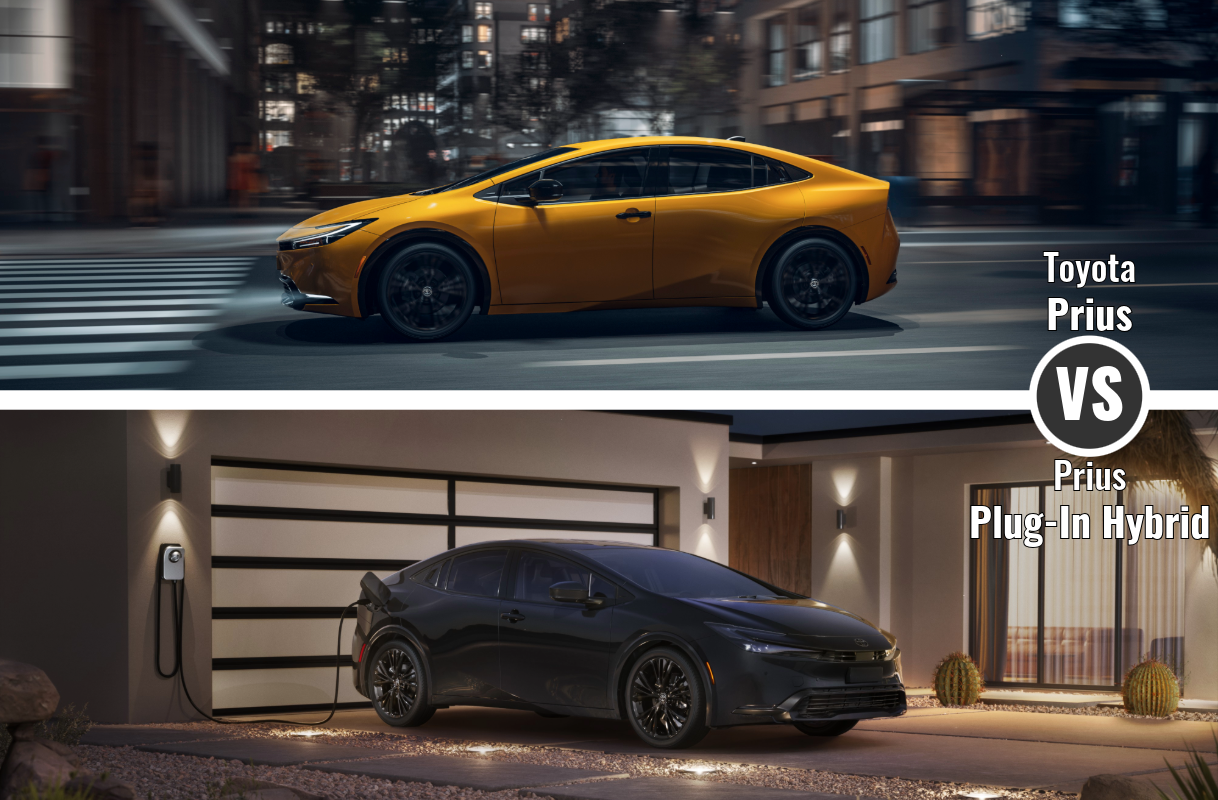
Toyota has been leading the charge of hybrid vehicle technology for about a quarter of a century now, and it all started with the first-generation Prius. Once met with skepticism and lighthearted jabs, the Prius has come a long way since its unveiling, and it’s now considered one of the most important cars of the 21 st century. Over the years, Toyota continued to improve on the Prius, and about a decade ago, as plug-in hybrid technology began to take off, Toyota released the plug-in version of the Prius. Like other PHEVs, it boasted a beefy rechargeable battery pack that allowed electrified driving for a certain range of miles. Now, both the 2026 Prius and 2026 Prius Plug-in Hybrid are still massively popular among shoppers near Fort Worth. But is the powertrain the only difference between these two gas-savers? For folks out there who are considering both, let’s compare the two and see which one might be the best fit for you. more Prius vs. Prius Plug-in Hybrid: Fuel Economy Let’s get the most obvious one out of the way first: because of their different powertrains, Prius Plug-in Hybrid’s MPG is quite different from the classic Prius. With the LE trim, the 2026 Prius is capable of 57 MPG in the city and 56 MPG on the highway, or a combined 57 MPG. Other Prius grades with all-wheel drive and larger tires get lower fuel economy, but even trims like the Nightshade Edition AWD still returns a solid 49 MPG combined. One of the major benefits of the 2026 Prius Plug-in Hybrid is that it’s capable of an estimated 44 miles of all-electric driving, which means that it doesn’t burn a single drop of gasoline. It also gets up to 53 MPG in the city and 51 MPG on the highway, or 52 MPG combined, when not running on battery power. While this is slightly lower than the regular Prius, as long as the battery has some juice in it, it’s rated for up to 127 MPGe, which puts it in a definitive lead—just make sure you keep it charged to benefit from its full potential. One final note about the Prius PHEV: using a 120-volt outlet, it’ll take about 11 hours to charge fully, but a properly equipped 240-volt outlet can get the job done in about 4 hours. Prius vs. Prius Plug-in Hybrid: Performance The Prius is motivated by a 2.0-liter 4-cylinder engine with a hybrid system that cranks out either 194 or 196 horsepower, depending on the drivetrain—it can be optioned in either front-wheel drive or all-wheel drive. When equipped with AWD, it can travel from 0 to 60 in about 7.0 seconds. The Prius Plug-in Hybrid is also powered by a 2.0-liter 4-cylinder motor, but its hybrid system is more robust, pushing out a total of 220 horsepower and a bit more torque. This boost gives it a slightly quicker 0 to 60 time of about 6.6 seconds. However, the Prius PHEV can only be equipped with front-wheel drive, which gives the regular Prius a bit of an edge during bad weather and light off-roading. Prius vs. Prius Plug-in Hybrid: Interior Space Viewed from the outside, the Prius and Prius Plug-in Hybrid look pretty much the exact same—their length, width, height, and wheelbase are all but identical. They have very similar interior dimensions too, but the Prius Plug-in Hybrid’s heftier battery pack reduces its interior capacity just a bit. Here’s a side-by-side comparison: 2026 Prius 2026 Prius Plug-in Hybrid Passenger capacity 5 5 Head room (front/rear) 38.0 / 36.4 in 38.0 / 36.4 in Shoulder room (front/rear) 55.3 / 52.8 in 55.3 / 52.8 in Hip room (front/rear) 54.7 / 51.7 in 54.7 / 51.7 in Leg room (front/rear) 43.2 / 34.8 in 42.4 / 35.9 in Passenger volume 91.2 cu ft 91.2 cu ft Max cargo volume (seats up) 23.8 cu ft 20.3 cu ft While differences are mostly negligible, the Prius has a bit more room in the front row and in the cargo area, while the Prius Plug-in Hybrid has slightly more room for rear seat passengers. Prius vs. Prius Plug-in Hybrid: Technology In terms of their interior features, both are incredibly similar. The Prius and Prius Plug-in Hybrid have an 8.0-inch center touch screen in the lower trims, while the higher trim levels come with a larger 12.3-inch Toyota Audio Multimedia setup. Regardless of which screen size you opt for, all come with Bluetooth, wireless Apple CarPlay® and Android Auto™, one USB media port, five USB charging ports, and compatibility with the full range of Toyota Connected Services including in-vehicle Wi-Fi. Prius vs. Prius Plug-in Hybrid: Safety Both models come standard with Toyota safety Sense™ 3.0 for 2026, which includes the following features: Full-Speed Range Dynamic Radar Cruise Control (DRCC) Pre-Collision System with Pedestrian Detection (PCS w/PD) Lane Departure Alert with Steering Assist (LDA w/SA) Lane Tracing Assist (LTA) Road Sign Assist (RSA) Automatic High Beams (AHB) Proactive Driving Assist (PDA) In addition, both come standard with Blind Spot Monitor (BSM) with Rear Cross-Traffic Alert (RCTA) and Safe Exit Alert (SEA). The Prius Plug-in Hybrid also has standard Traffic Jam Assist (TJA), and both have available Panoramic View Monitor (PVM) and Front and Rear Parking Assist with Automatic Braking (PA w/AB). Prius vs. Prius Plug-in Hybrid: Price Generally speaking, hybrids tend to be a bit less expensive than plug-in hybrids, and that’s true of the Prius and Prius Plug-in Hybrid. Here’s their respective MSRP by grade: 2026 Toyota Prius: LE: $28,550 XLE: $31,995 Nightshade Edition: $32,800 Limited: $35,565 2026 Toyota Prius Plug-in Hybrid: SE: $33,775 XSE: $37,025 Nightshade Edition: $37,795 XSE Premium: $40,470 Essentially, the up-front cost vs. long-term gas mileage is the most important factor to consider when choosing between these two models. If you need help calculating your monthly payment and fuel costs, contact the hybrid experts at our Toyota dealership in Burleson and we’ll help you choose the right Prius for your lifestyle. Shop Toyota Prius Models for Sale Near Cleburne, TX Now that you know all the important differences between the two, you’re ready to make an informed decision and pick the perfect Toyota hybrid for you. At Family Toyota of Burleson, we have an excellent selection of new Prius and Prius Plug-in Hybrid models for sale. Be sure to check out our new car specials to find low APR financing so you can get the most affordable monthly payment possible. Ready to schedule a test drive? Call us today at 817-405-3122 or contact us online with any questions. Frequently Asked Questions What’s the Difference Between the Prius Plug-in Hybrid and Prius Prime? The Prius Plug-in Hybrid and Prius Prime are the exact same in everything but name—Toyota simply chose to change the name from Prius Prime to the Prius Plug-in Hybrid for the 2025 model year in order to eliminate confusion among shoppers. Is the Prius or Prius Plug-in Hybrid More Cost Efficient? The Prius has a significantly lower starting price, which may make it more appealing to shoppers on a budget. However, the Prius Plug-in Hybrid gets up to 127 MPGe, which means that it has far lower fuel costs as long as you’re able to regularly recharge the battery. Which is Faster, Prius or Prius Plug-in Hybrid? The Prius PHEV has more horsepower and a slightly faster 0 to 60 time than the Prius.
Toyota 4Runner vs. Grand Highlander: Which is Right for You?

Toyota 4Runner vs. Grand Highlander: Which is Right for You?

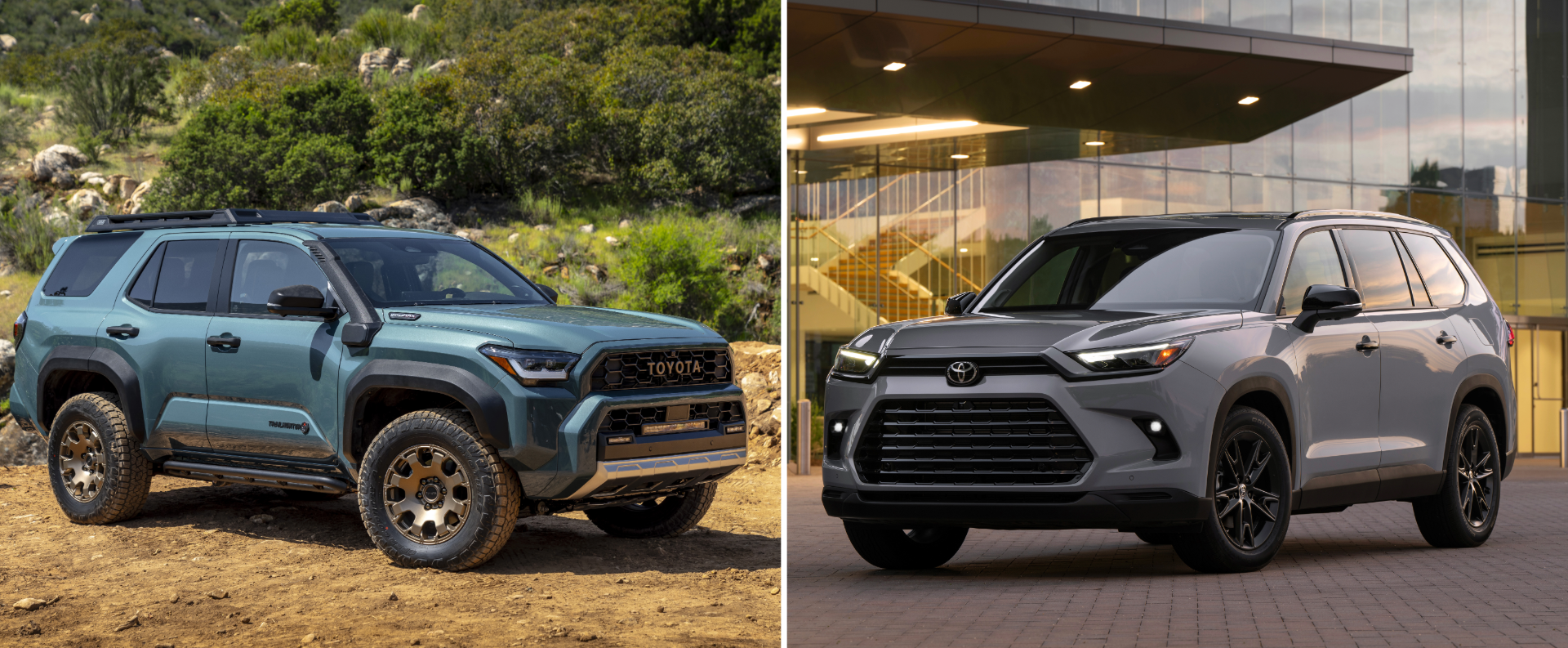
Toyota has one of the largest assortments of SUVs in the industry, from compact city cruisers to hulking off-road conquering machines. There’s one out there for just about everybody, but that can make picking the right model a bit complicated for shoppers near Alvarado, TX. The 4Runner and Grand Highlander are two excellent examples of three-row SUVs that are designed to do very different things. Discover their specs, features, and more below, and discover just how versatile the Toyota lineup can be. more 4Runner vs. Grand Highlander: Price First, let’s do a head-to-head comparison of their MSRP by trim: 2025 Toyota 4Runner 2025 Toyota Grand Highlander SR5 $40,770 $40,860 LE TRD Sport $47,250 $43,630 XLE TRD Off-Road $49,190 $44,210 Hybrid LE TRD Off-Road i-FORCE MAX $51,990 $45,380 Hybrid XLE TRD Sport Premium $52,610 $48,360 Limited TRD Off-Road Premium $54,970 $51,710 Hybrid Limited Limited $55,400 $52,610 Hybrid Nightshade TRD Off-Road Premium i-FORCE MAX $57,770 $54,045 Platinum Limited i-FORCE MAX $60,200 $54,690 Hybrid MAX Limited Platinum $62,860 $58,775 Hybrid MAX Platinum TRD Pro $66,900 Trailhunter $66,900 They start out at almost exactly the same price point, and continue to be similarly priced throughout the lineup, although the 4Runner costs an extra few grand on average. The 4Runner also has the most expensive MSRP with its top-spec TRD Pro and Trailhunter grades. 4Runner vs. Grand Highlander: Size Both the 4Runner and Grand Highlander are sizeable SUVs with up to three rows of seating, but their exact dimensions differ significantly. Here’s a breakdown: 2025 4Runner 2025 Grand Highlander Exterior dimensions Length 194.9 in 201.4 in Width 78.0 in 78.3 in Height 72.6 in (varies by trim) 70.1 in Wheelbase 112.2 in 116.1 in Interior dimensions Max seating capacity 5 to 7 7 to 8 Head room (1 st /2 nd /3 rd) 39.7 / 37.8 / - 41.5 in / 40.2 in / 37.2 in Leg room (1 st /2 nd /3 rd) 41.8 / 34.8 / - 41.7 in / 39.5 in / 33.5 in Cargo volume behind 3 rd row 12.1 cu ft (w/ 3 rd row) 20.6 cu ft Cargo volume behind 2 nd row 44.8 cu ft (w/ 3 rd row) 48.4 cu ft (w/o 3 rd row) 57.9 cu ft Cargo volume behind 1 st row 84.4 cu ft (w/ 3 rd row) 90.2 cu ft (w/o 3 rd row) 97.5 cu ft The Grand Highlander is longer, but lower to the ground with a longer wheelbase for more stability. It also has significantly more space inside, and comes standard with three rows of seating, making it far better for road trips and families who do most of their driving on paved roads. The 4Runner comes standard with two rows of seating, and a third row is available on some trims. However, the third row is smaller than the Grand Highlander’s, and the 4Runner has significantly less space for cargo in the back. It’s still far more spacious than most SUVs, but its dimensions are geared more toward drivers who like to spend more of their time off the beaten track. 4Runner vs. Grand Highlander: Interior Aside from their cabin dimensions, they have some key differences when it comes to comfort features and infotainment. The recently updated 4Runner got a wealth of new tech features for its newest generation. It can be optioned with either an 8.0-inch or a 14.0-inch center touch screen display, and it also has a 12.3-inch digital gauge cluster, dash-mounted portable Bluetooth speaker, and wireless charging pad as available upgrades. Despite the tech upgrades, it still retains that spartan, less-frills vibe that the 4Runner is known for, and it can also be optioned with a ton of off-road ready gear, including an onboard air compressor and pre-wired DC auxiliary switches. The Grand Highlander, on the other hand, is designed to provide a borderline luxury driving experience. It comes standard with a 12.3-inch center touch screen display, and nearly all trims have the 12.3-inch digital gauge cluster, wireless phone charging, and premium upholstery materials. It also has a wealth of other available amenities like multi-zone climate control, heated and ventilated seats, and a panoramic moonroof. Both the 4Runner and Grand Highlander are also compatible with connectivity tech like wireless Apple CarPlay® and Android Auto™, Digital Key, and the full range of Toyota Connected Services, including in-vehicle Wi-Fi Connect. 4Runner vs. Grand Highlander: Fuel Economy The Grand Highlander Hybrid gets excellent fuel economy, making it perfect for long commutes and errands—its four-cylinder engine combined with two electric motors allows it to get up to 36 MPG combined. It also has an available Hybrid MAX powertrain, which delivers souped-up performance while still enabling up to 27 MPG combined. The 4Runner’s available hybrid i-FORCE MAX powertrain is more fuel-efficient than the previous generation, but at the end of the day, saving money on gas takes second fiddle to maximum power output, and it gets about 23 MPG combined. 4Runner vs. Grand Highlander: Ride Quality In terms of smoothness on the highway, the Grand Highlander takes the cake. Its longer wheelbase, combined with its suspension, sound deadening technology, and unibody construction make it a better choice for shoppers who want a quiet and comfortable ride on the open road. On the other hand, the 4Runner is going to feel a bit rougher because of its larger all-terrain tires and body-on-frame build. Shoppers who spend most of their time on paved roads may want to consider shopping for more highway-oriented tires. 4Runner vs. Grand Highlander: Off-Road and Performance The 4Runner is well-known as a champion of overlanding aficionados everywhere. Its i-FORCE MAX engine cranks out 326 horsepower and 465 pound-feet of torque, and it has a cornucopia of available features that aid in off-roading, including: A choice between two-wheel drive, part-time four-wheel drive, or full-time four-wheel drive Adaptive variable suspension Electronic locking rear differential Stabilizer disconnect mechanism Underbody protection and skid plates Front and rear recovery points Multi-Terrain Select Crawl Control It also has multiple available grades, like the TRD Pro and Trailhunter, that have their own uniquely tuned suspensions and accessories for even more off-road fun. The Grand Highlander may not be quite as capable as the 4Runner, but it still has more than enough moxie to do some backwoods camping and light trail running. It can also be optioned with all-wheel drive, as well as multiple available drive modes with Multi-Terrain Select. Shop Three-Row Toyota SUVs for Sale Near Mansfield, TX The Grand Highlander and 4Runner may excel at different things, but they both offer Toyota’s second-to-none standard of reliability, quality, and safety. So, which one will you choose? If you’re still having trouble deciding, Family Toyota of Burleson is here to help you with expert advice and quality customer care. We also have a variety of new car specials and Toyota lease deals, so no matter which vehicle you fall in love with, you’re guaranteed to get it at the best price. Contact us online or call us at 817-405-3122 to schedule a test drive today.

Contact Us

Fill out this form below and we'll contact you shortly
*Required Fields